Is Running Bad for Your Knees? How Your Quads Work as a Braking System
Running puts roughly 5x your bodyweight through your kneecap. Here is how your quads work as a braking system, why that load is normal, and how to manage it and build the strength to handle it.


“Running is bad for your knees” (said no performance PT ever).
Yes, there is a large amount of load that goes into your knees when you run, but the body can be very good at managing that load and adapting to it. Understanding exactly what happens during running, why it matters, and what you can do about it can help set you up for a life of many miles to come.
Your quads aren’t just for knee extension
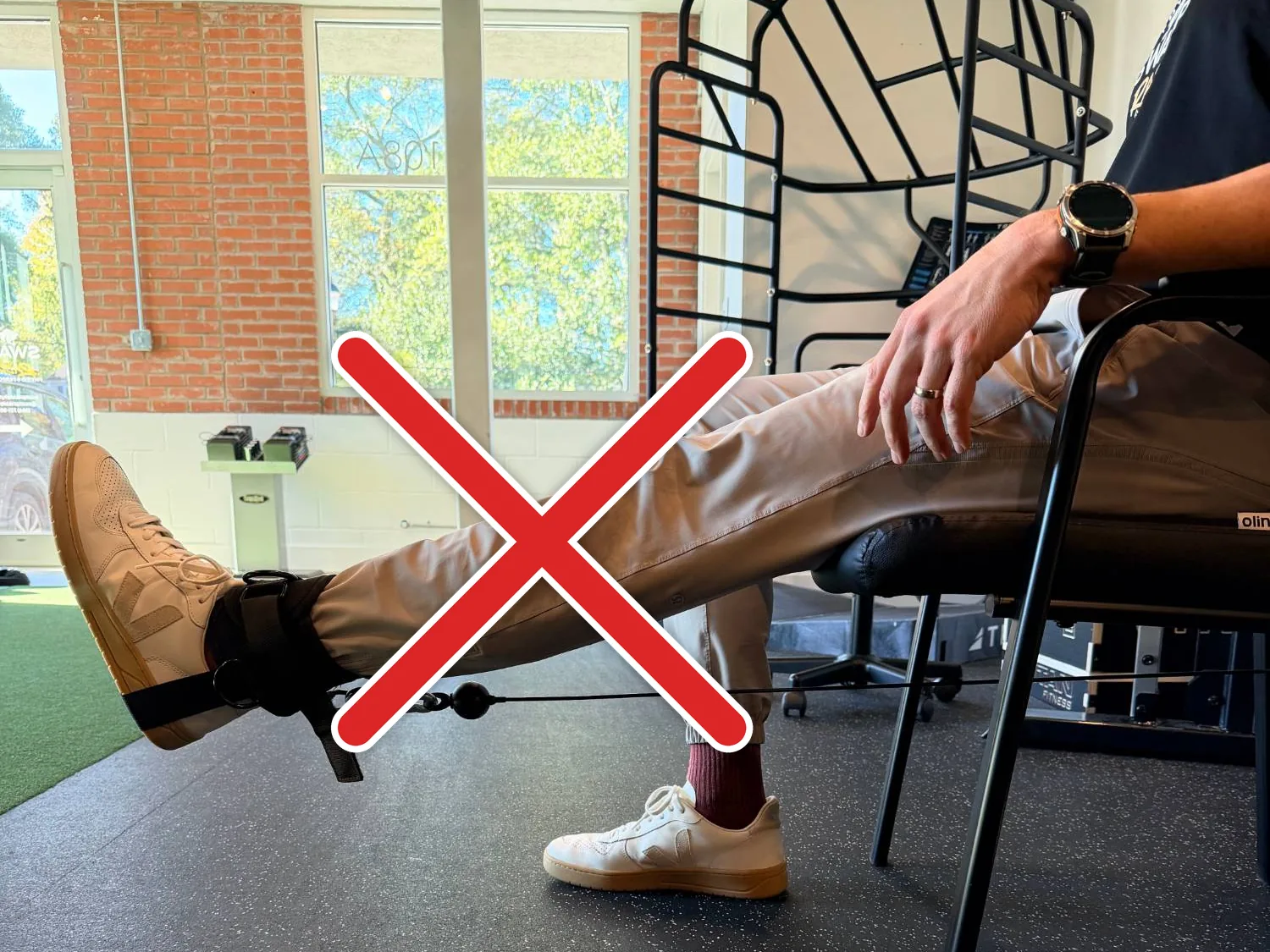
The thing most people think the quads do is perform knee extension. And while that is true, one of their biggest jobs during running is actually putting on the brakes when the foot contacts the ground and the body begins to travel over the foot.
When the foot first contacts the ground, forces acting on the body create a tendency for the knee to move into flexion. During this time, the quads work hard to control that movement and slow it down. Even though the knee is still flexing, the quads are producing force while lengthening — an eccentric muscle action.
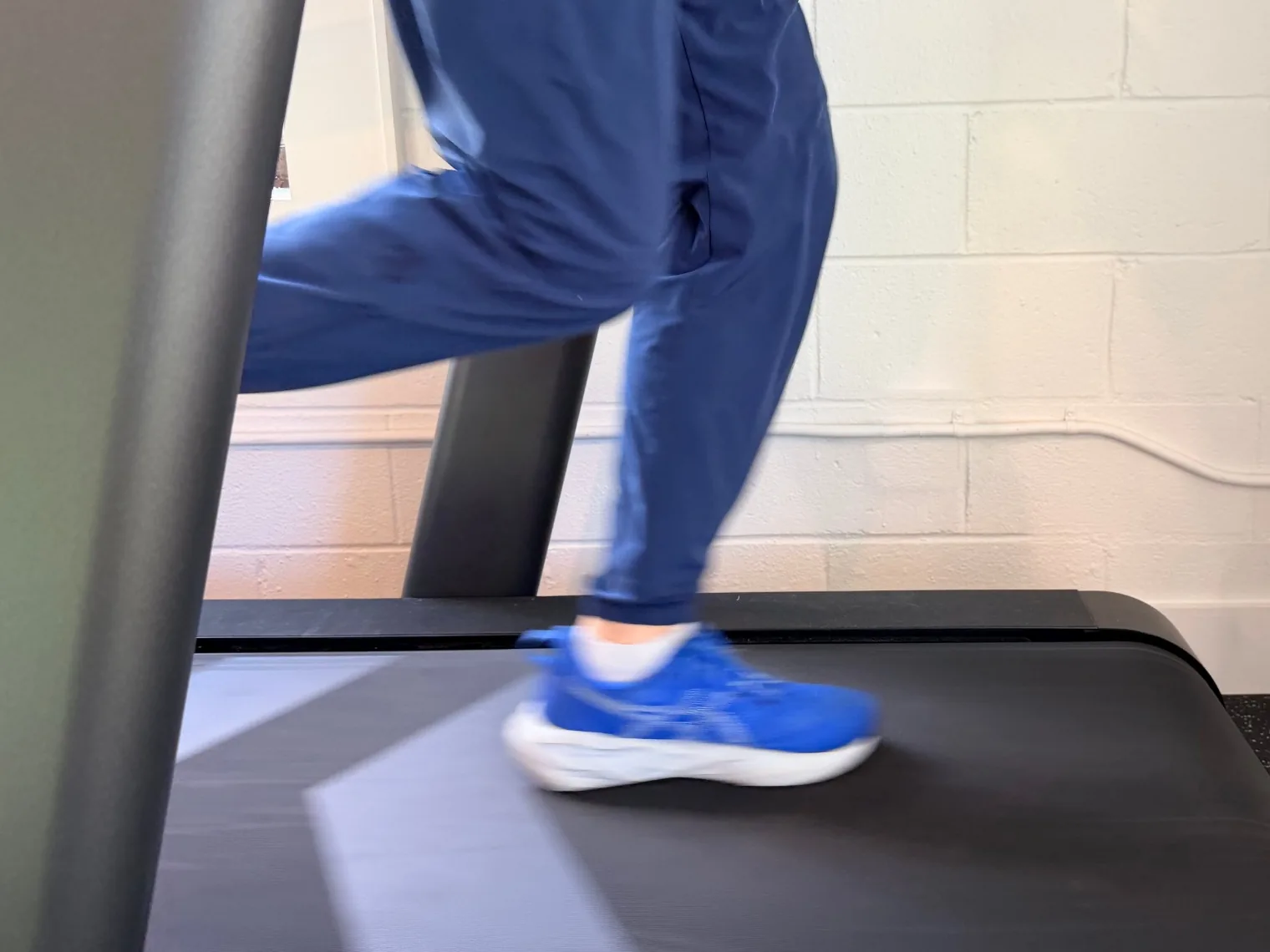
This is referred to as negative work, because the muscles are dissipating mechanical energy rather than generating it. Later in the stance phase, as the knee begins to extend, the quads can transition toward positive work, contributing to energy generation. A research group used a musculoskeletal model to demonstrate this basic pattern: the knee extensors dissipated energy during knee flexion and generated energy during knee extension.
A simple flow of what is happening looks like this:
Ground reaction force → knee flexion moment → quadriceps produce an opposing knee extension moment → the knee continues to flex under control → the quadriceps dissipate mechanical energy
This is the active “braking” or shock-absorption mechanism we’re interested in.
But what does that mean for your kneecap?
The quads aren’t the only part of the knee involved here. The patellofemoral joint (PFJ) is where we can see one of the consequences of the quadriceps doing their job.
The PFJ is the joint between the patella (kneecap) and the femur (thigh bone). The quadriceps tendon attaches the quads to the patella, and the patellar tendon continues from the patella to the tibia. When the quads produce force, that force contributes to compression between the patella and femur.
And this is where things get more interesting.
The foot lands on the ground. The quads produce force to help control the body’s movement. That quadriceps force also creates compression at the PFJ.
The same system that helps us control and absorb mechanical energy also creates substantial force at the kneecap.
And this isn’t necessarily a bad thing. In fact, it is a completely normal part of running. Our joints and tissues are designed to experience and adapt to mechanical loading.
How much force are we talking about?
A systematic review and meta-analysis found that the average peak patellofemoral joint reaction force during running was approximately 5 times bodyweight in healthy individuals.
For a 150-pound runner, that’s roughly 750 pounds of peak force within the PFJ.
That number sounds enormous — and it is — but it is important to understand what it actually means. This isn’t 750 pounds of force “slamming” into your kneecap every time your foot hits the ground. It is an estimate of the peak reaction force within the patellofemoral joint as the muscles and joint interact throughout the running stride.
The takeaway isn’t that running is destroying your knees.
The takeaway is that running is a high-load activity, and your body has to be capable of managing that load.
So can we change how much load goes through the knee?
Yes. Running mechanics can influence the demands placed on the knee.
One example is cadence, or how many steps you take per minute.
When runners increase their cadence, they generally take shorter steps. Research has found that increasing step rate can reduce mechanical energy absorption at the knee, and studies specifically examining the PFJ have found reductions in PFJ force and stress with increased step rate.
A recent systematic review also found that increased step rate and decreased step length generally reduced PFJ force and stress, while decreased step rate and increased step length tended to increase them.
But this doesn’t mean everyone should suddenly start running at 180 steps per minute.
Instead, think of cadence as a tool for managing load.
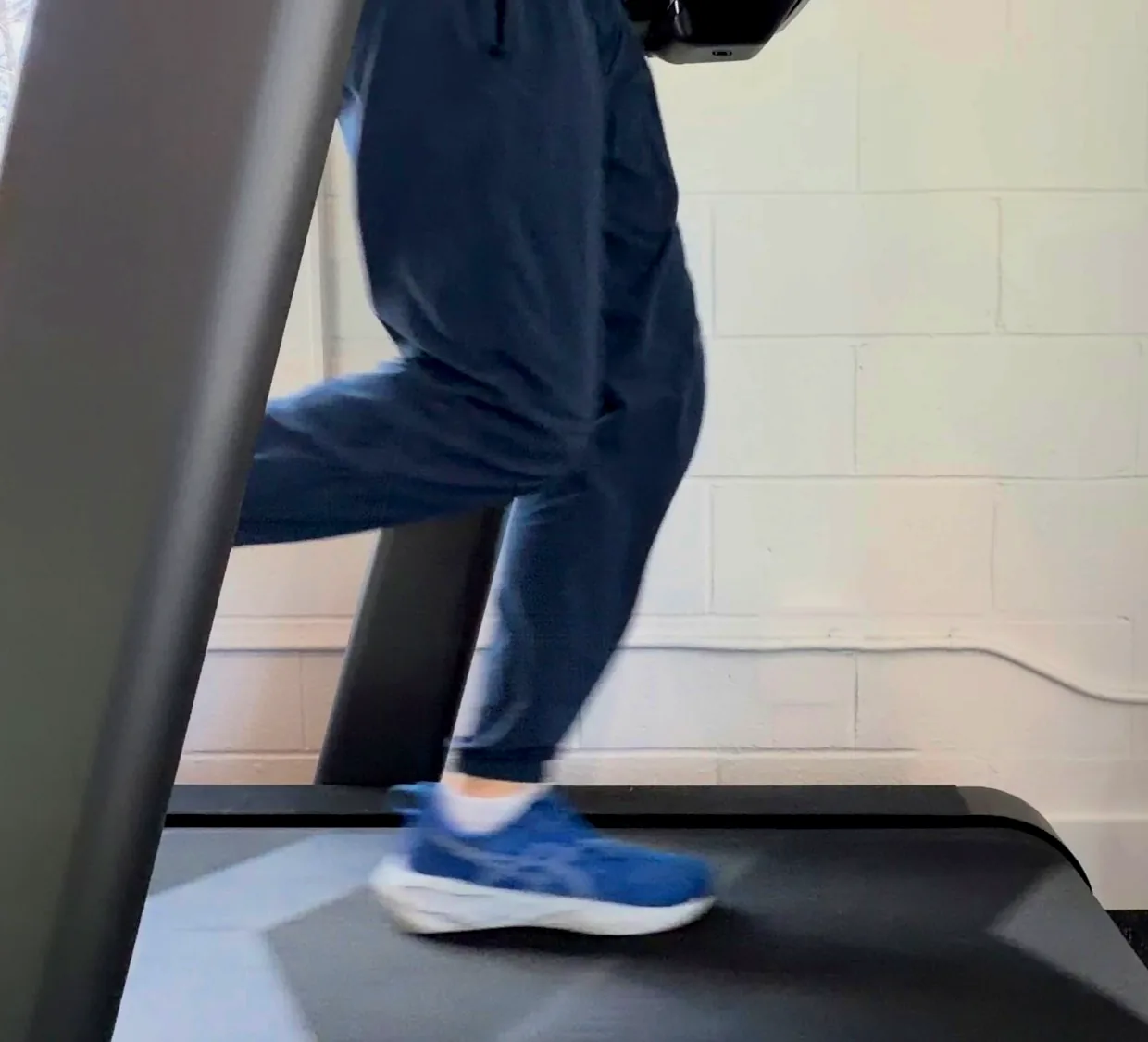
If someone is experiencing knee pain, one practical experiment can be increasing their current cadence by roughly 5% and seeing how their symptoms and running mechanics respond. For a 160 steps per minute runner, that would look like increasing cadence to 168 steps per minute. This is not a universal prescription, and it isn’t something every pain-free runner needs to change. It is simply one way we can manipulate running mechanics when we want to temporarily reduce knee loading.
Terrain can matter, too.
Downhill running in particular can increase the demands placed on the knee’s braking system. One study comparing level, uphill, and downhill running found greater peak PFJ stress and cumulative PFJ stress during downhill running than during level or uphill running.
So if your knees are already irritated, temporarily reducing downhill running — or choosing flatter routes — can be a practical way to continue running while reducing one source of mechanical stress.
But managing load is only half the equation
We can change how much load the knee experiences, but we also need to consider the body’s capacity to handle that load.
In theory, we could build that capacity simply by running more. But running gives us a very specific type of stimulus: thousands of repeated loading cycles.
If we continually increase running volume, speed, hills, or other demands simply to make the tissues stronger, we eventually run into a problem: we’re using more of the same activity to create the adaptation, while simultaneously increasing the total amount of running stress we’re asking the body to recover from.
This is where strength training becomes useful.
Strength training gives us a way to expose the muscles and joints to high levels of force in a controlled environment, without having to add more miles to our running.
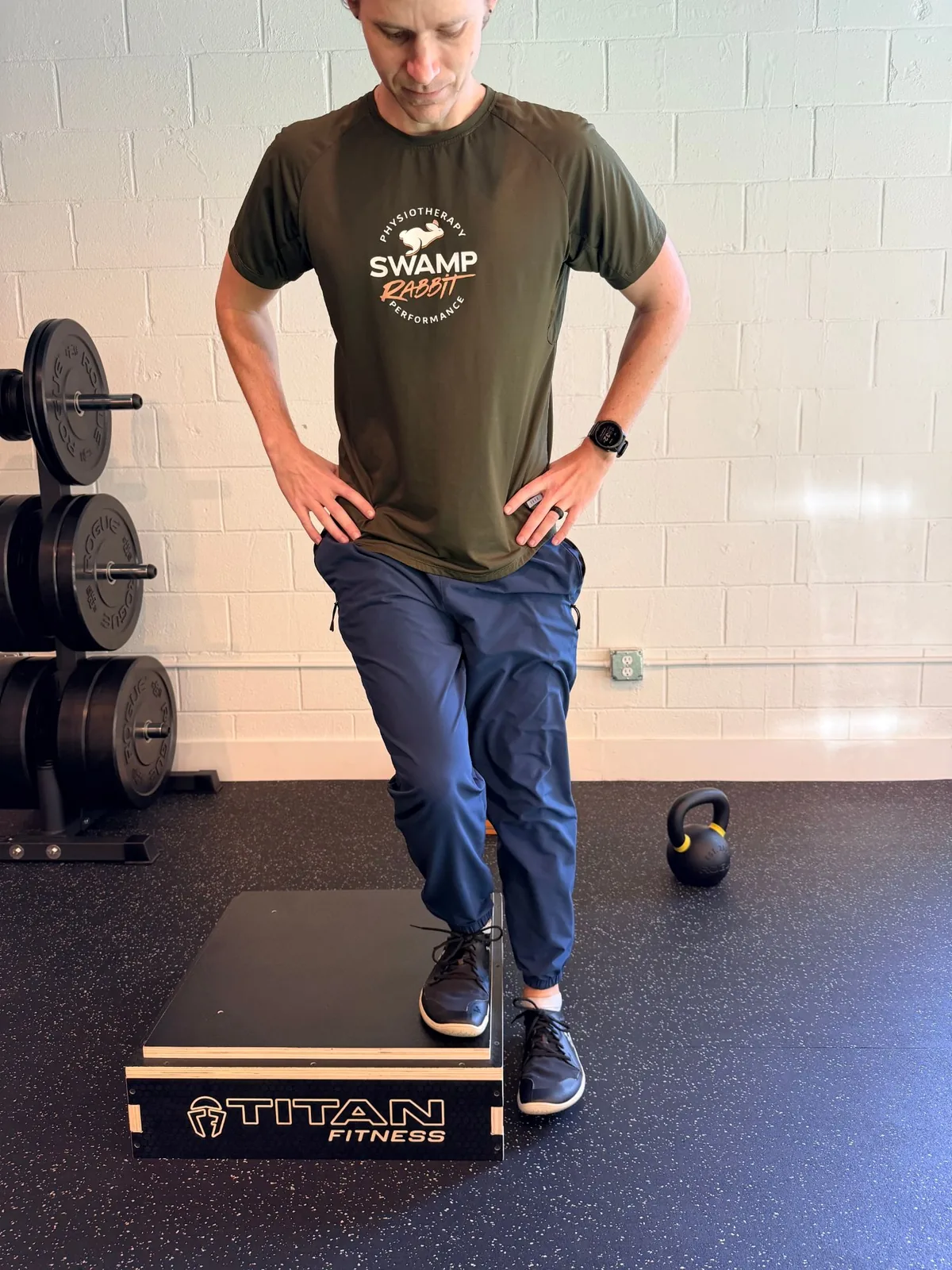
And there is a performance benefit here, too. Systematic reviews and meta-analyses consistently show that incorporating strength training — particularly high-load resistance training — can improve running economy and, in many studies, running performance.
For a runner, that means strength training isn’t simply about “protecting the knees.”
It is a way to build the physical capacity to handle the demands of running while potentially making you a better runner in the process.
What does that look like?
The good news is that runners don’t necessarily need a huge amount of strength training.
Running already provides an enormous amount of repetitive, sport-specific loading. Strength training can fill in the piece that running doesn’t provide as well: high-force, progressive loading.
A practical strength program can therefore be relatively simple:
- Knee-dominant strength: squats, split squats, step-ups, leg press, etc.
- Single-leg strength: movements that challenge each leg independently.
- High-quality, relatively heavy sets: enough load to create a meaningful strength stimulus without turning the workout into another endurance session.
- Optional plyometrics: jumps, hops, or other explosive exercises can provide a complementary stimulus by training the ability to produce and absorb force quickly.
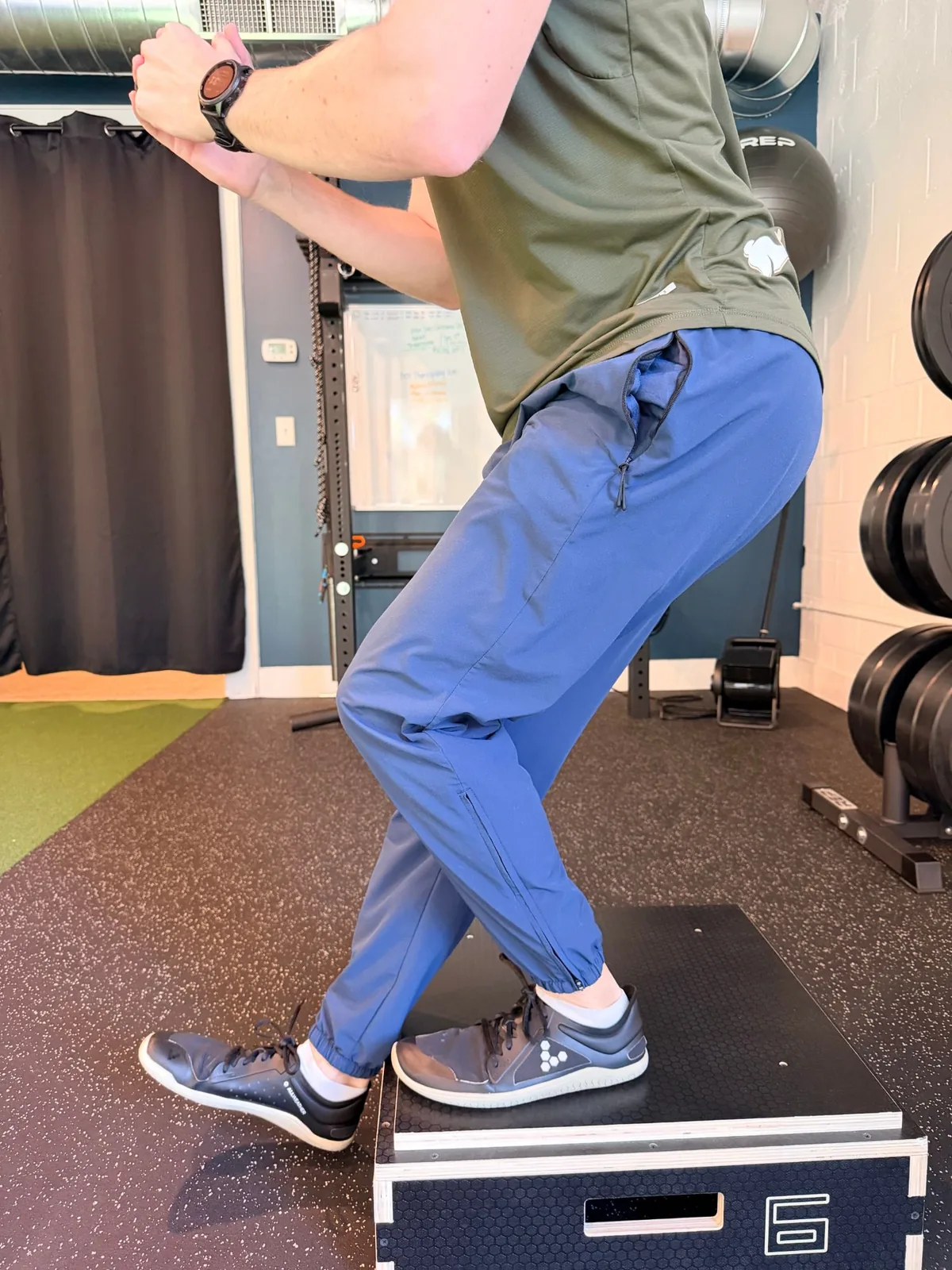
You don’t need five different quad exercises in the same workout.
For many runners, 1–2 primary lower-body strength movements performed for a few challenging sets can provide a meaningful stimulus. Across the research, strength-training programs vary considerably in frequency and volume, but benefits have been demonstrated with relatively modest programs performed around 2–3 times per week.
The goal isn’t to completely exhaust your legs.
Think high quality, not high volume.
You should be working hard enough that the final few repetitions are challenging, but you don’t need to take every set to failure. The strength session should ultimately support your running rather than compete with it.
And plyometrics can be a useful addition, but they aren’t something every runner needs to immediately add. They are another way to develop force production and force absorption, and can be incorporated progressively once a runner has an appropriate foundation of strength and running tolerance.
The big picture
Running creates repetitive loading through the knee.
The quadriceps are a major part of managing that load. They act as an active braking system during early stance, helping control knee flexion and dissipate mechanical energy. As a consequence of producing that force, they also contribute to substantial loading at the patellofemoral joint.
None of this is inherently bad. It’s running.
The goal isn’t to eliminate the forces going through your knees. It’s to make sure your body has the capacity to handle the forces you’re asking it to handle.
That means we have two primary tools:
Manage the exposure: Adjust things like running volume, speed, hills, or cadence when the current load exceeds your ability to tolerate it.
Build the capacity: Use progressive strength training to expose the muscles and tissues to high-quality loading in a controlled way.
And remember: more isn’t always better.
The goal isn’t to see how much stress you can pile onto your knees in a week. The goal is to provide enough stimulus to create adaptation while still recovering well enough to do the running that you actually care about.
That’s how we build knees that aren’t just capable of handling today’s mileage, but are built to run for years to come.
Want to become a stronger, more resilient runner?
Understanding running biomechanics is one thing. Figuring out what your body specifically needs — and putting that knowledge into practice — is another.
At Swamp Rabbit Physiotherapy and Performance, we work with runners to identify the strength, mobility, movement, and training factors that may be limiting their performance or contributing to recurring injuries.
Whether you’re trying to stay healthy through marathon training, finally break that 5K PR, or simply become a stronger and more confident runner, we’d love to help.
Want to learn more or work with us? Connect with Swamp Rabbit Physiotherapy and Performance to learn more about our running-focused physical therapy and performance services.
Frequently Asked Questions
Ready to make your training bulletproof?
Book a 60-minute assessment with a Doctor of Physical Therapy in Greenville. No referral needed.
Book Your Assessment
