Strength Training for Runners: How to Make It Actually Help Your Running
Running is hard on the body. Strength training should support it. Here is how to time it, what to lift, and how to keep your strength work from hurting your running.


Running is hard on the body. Strength training should support it. Most runners know that. It’s not the “what” that’s confusing, but the “how” that is harder to figure out.
People strength train for all different reasons, so everyone has their own structure. The way runners can optimize their strength training is unique. You’re trying to fit strength workouts around your running while also targeting the movements that will be most beneficial for you.
First, timing matters.
For strength training to really support your running, there has to be enough time to recover after a strength session before your next hard run.
If running performance is the priority, run first, strength train second.
A straightforward approach is to stack your strength training on the same day as a hard run. Ideally, separate the strength session by several hours — 6 hours is a good target when your schedule allows — but it can also be done immediately following a hard run if needed.
The next day should be either an easy run or an off day. This is the “keep the hard days hard and the easy days easy” approach.
Then, when possible, allow roughly 48 hours before your next key run (another hard workout or long run). This gives your muscles time to recover so you can perform at your best when it matters.
Next, exercise selection has to be intentional.
For runners, think about strength training in terms of movement categories:
- Squat
- Hip hinge
- Lunge
- Direct calf work
- Plyometrics
You don’t need to do every possible exercise in each category, and there isn’t one “perfect” exercise for runners. The principles are more important than the specific exercise you choose.
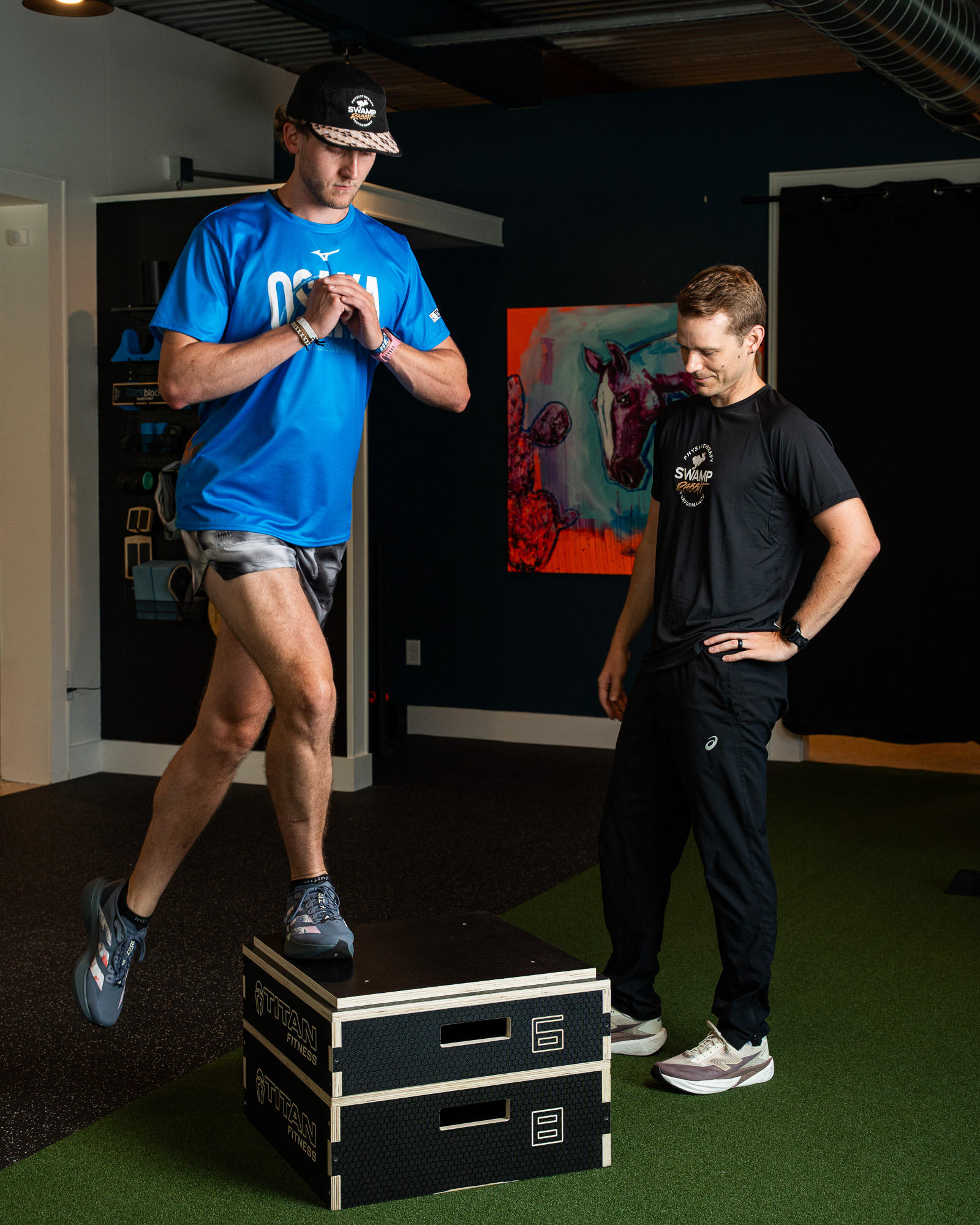
A good strength session can follow a general flow of plyometrics first, then a heavy double-leg movement, a heavy single-leg movement, and finally direct calf work.
For example, this could look like:
Plyometrics → Squat → Single-leg/hinge → Calf
The strength exercises should be challenging. You don’t need to train to failure, but you should finish most sets feeling like you could perform about 2–4 more repetitions if you absolutely had to.
Depending on the exercise, your experience with strength training, and your specific goal, 3–4 sets of 5–12 repetitions is a good starting point for your primary strength exercises.
The goal isn’t to leave the gym completely exhausted. The goal is to provide enough of a stimulus to build strength and resilience without creating so much fatigue that it negatively affects your running.
Finally, remember that strength training is there to support your running — not compete with it.
If you’re training for a race, your running workouts are the priority. Strength training should complement those workouts, not make it harder to complete them.
That means your strength training may look different during different parts of your training cycle. You might lift heavier during a base phase and reduce volume as you get closer to a race. You may also need to adjust your exercises, sets, or reps based on your running volume and how your body is responding.
There is no single “best” strength program for every runner. But if you get the big things right — timing, exercise selection, appropriate intensity, and managing fatigue — you can make your strength training work for your running rather than against it. If you’re unsure where to start, a running gait analysis is a great first step.
If you’re dealing with an injury, recurring pain, or simply want to better understand how your strength training can support your running, reach out to Swamp Rabbit Physiotherapy & Performance. We work specifically with runners to keep you healthy, improve performance, and help you keep doing what you love.
Ready to make your training bulletproof?
Book a 60-minute assessment with a Doctor of Physical Therapy in Greenville. No referral needed.
Book Your Assessment