Calf and Achilles Training for Runners: What the Research Says and How to Actually Do It
Your Achilles handles roughly 6–8x your bodyweight every stride. Here is what the research says about calf and Achilles strength for runners — and exactly how to train it.


Calves play a pretty big role in running.
Think Robert Downey Jr as Iron Man in the MCU (sorry if you’re reading this and not a Marvel fan).
So let’s start by breaking down what we actually mean when we talk about the “calves.”
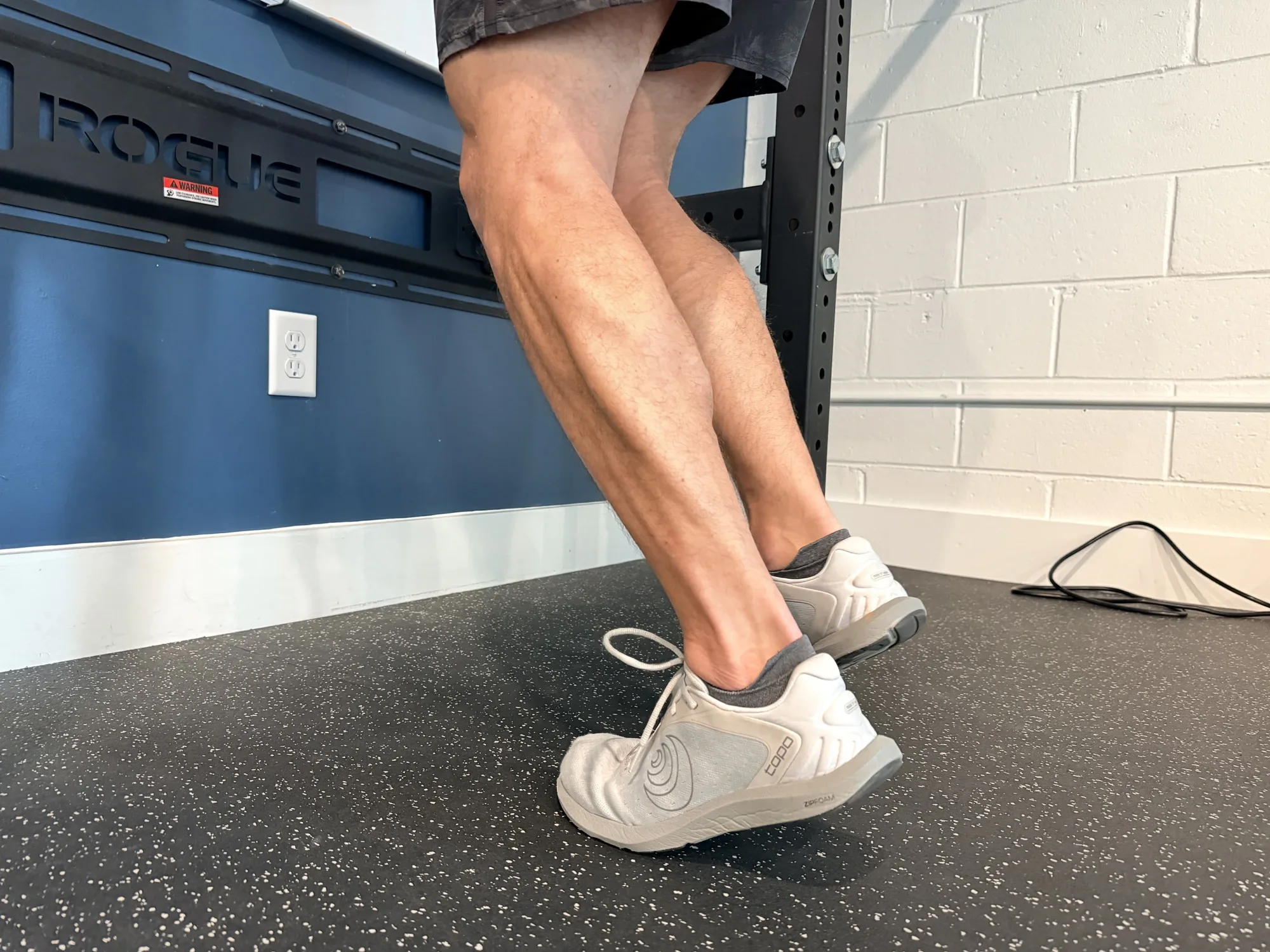
The two primary muscles we’re referencing are the soleus and gastrocnemius. Together, they make up much of the muscular portion of the calf and connect through the Achilles tendon to the heel. The muscles and tendon work together as a muscle-tendon unit (MTU).
And this muscle-tendon unit does a lot of work when you run.
During the second half of the stance phase, the soleus and gastrocnemius are the dominant contributors to propulsion and support (some research attributing over 50% of forward propulsion to the soleus and gastroc). In other words, your calves aren’t simply helping you “push off” at the end of each stride — they are one of the primary systems responsible for helping you support and propel your body forward.
So what does that actually look like?
Your calves are dealing with some serious force
Peak Achilles tendon forces during running have commonly been estimated at roughly 6–8 times your bodyweight in biomechanical models.
Think about that for a second.
If you weigh 150 pounds, 6–8 times your bodyweight is roughly 900–1,200 pounds of internal tendon force.
And that’s happening repeatedly as you run.
Now, this doesn’t mean that your Achilles tendon literally has a 1,200-pound weight sitting on it. These are estimates of the internal tensile force generated within the tendon during running. The exact number varies depending on the runner, running speed and the method researchers use to estimate it. More recent measurement techniques have actually produced estimates above this range in some conditions.
The important takeaway isn’t whether your Achilles is experiencing exactly 6.5, 7.2 or 8 times your bodyweight.
It’s this:
Your calf-Achilles system is handling very large forces, over and over again, every time you run.
The Achilles: the spring of running
So why can your body handle all of this?
One big reason is the Achilles tendon.
Think of the Achilles as one of the major springs of running.
When your foot hits the ground and you move through stance, the calf muscles produce force and the Achilles tendon stretches, storing elastic energy. As you move toward the end of stance, the tendon recoils and returns much of that stored energy.
The Achilles doesn’t actively contract — it is a tendon, not a muscle. Instead, it acts as an elastic structure that allows the body to store and reuse mechanical energy.
That’s a big deal.
If your calf muscles had to actively generate all of the mechanical energy required to propel you forward every single stride, running would be considerably more metabolically expensive.
Instead, the muscle-tendon system allows some of that work to be handled through elastic energy storage and return. The plantarflexor muscle-tendon units are among the most important contributors to the mechanical power required for running.
And this is where things get really interesting.
Stronger calves may help you run more efficiently
Researchers have found that improving the strength and mechanical properties of the plantarflexor muscle-tendon unit can improve running economy.
In one 14-week study, runners completed a specific plantarflexor training program. After training, their plantarflexor strength increased by about 10%, Achilles tendon stiffness increased by about 31%, and the energy cost of running decreased by approximately 4%. The researchers found evidence that improved efficiency of the soleus contributed to this change.
A 4% improvement might not sound like much.
But it’s actually pretty significant.
Modern “super shoes” have been shown to improve running economy by roughly 2–4% in many studies, with some landmark research finding approximately a 4% reduction in metabolic cost.
So we’re talking about an improvement in the same general ballpark.
In other words:
Training your calves won’t literally turn your shoes into super shoes — but developing your plantarflexor strength and muscle-tendon properties may provide a surprisingly meaningful improvement in how efficiently you run.
And unlike a $250 pair of shoes, you get to keep the adaptation after the workout.
So how should runners train their calves?
This is where I think runners often miss the boat.
If you’re doing 15–20 bodyweight calf raises at the end of your workout until your calves burn, you’re certainly doing something.
But if the goal is to develop the capacity to handle the enormous forces of running, we should give the calf a stimulus that actually resembles the demands we’re asking it to meet.
That means progressively loading it with meaningful resistance.
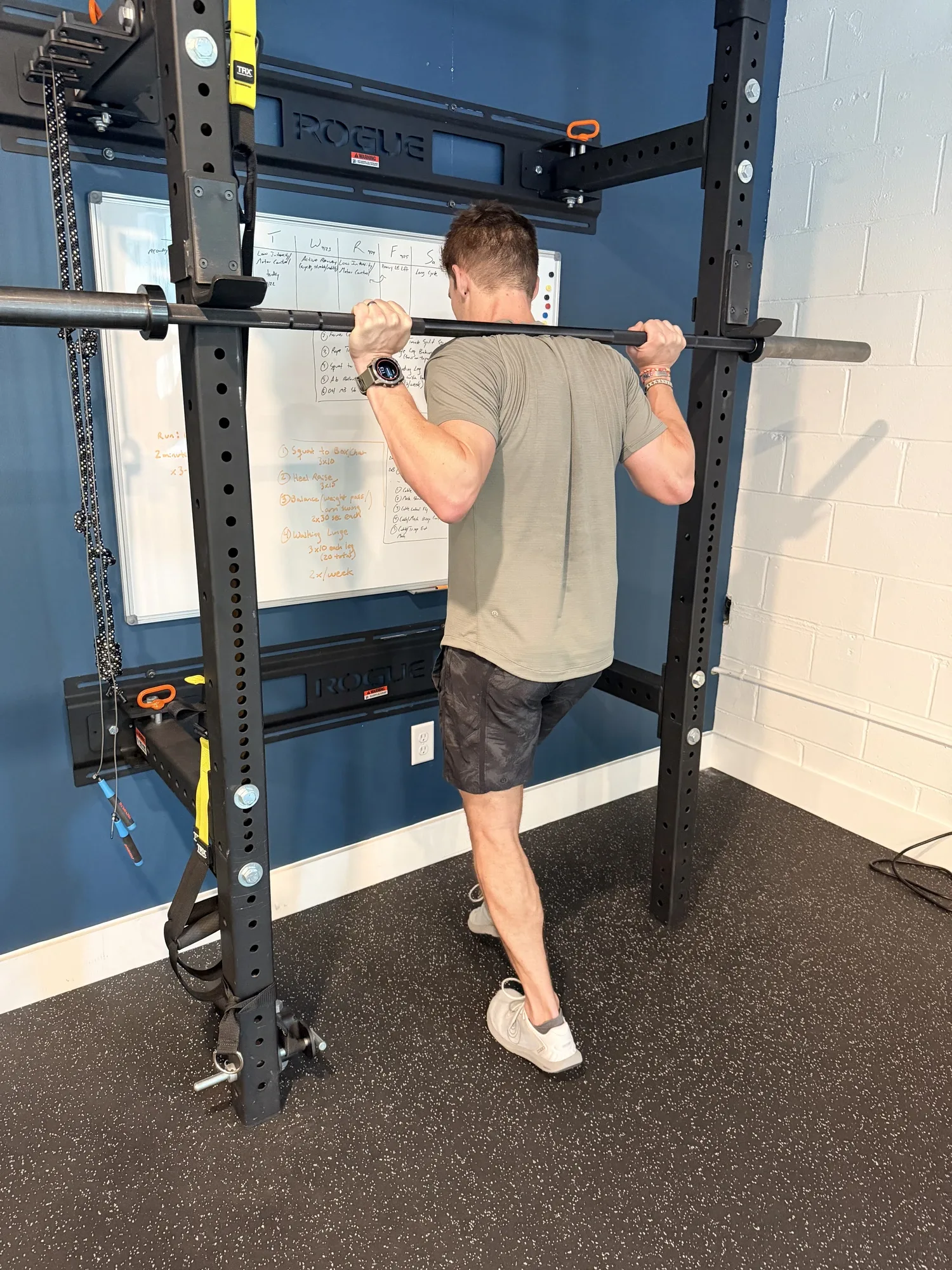
One practical starting point is heavy, slow calf raises.
For example:
3 × 6–8 reps
Use enough weight that the final few repetitions are genuinely challenging, while still maintaining good control through the full range of motion.
You don’t need to chase the heaviest weight possible. If you’re bouncing through the movement, shortening your range of motion, or losing control just to add another plate, you’ve probably gone too heavy.
The goal isn’t to impress the person next to you at the squat rack.
The goal is to make the tissue adapt.
And although 6–8 repetitions is a great practical range for heavy calf training, don’t interpret that as a magical number. Higher-repetition calf work can also produce adaptations. What matters most is that the muscle-tendon unit is exposed to an appropriate level of progressive loading, effort and volume.
Don’t forget about isometrics
Another way to load the calf-Achilles system is through high-intensity isometric contractions.
One research protocol that improved plantarflexor strength and Achilles tendon stiffness used repeated isometric plantarflexion contractions at approximately 90% of maximal voluntary contraction. Participants performed five sets of four contractions, holding each contraction for three seconds with three seconds of relaxation, three to four times per week for 14 weeks.
You don’t necessarily need to reproduce that exact protocol in your training.
A simple practical version could look like:
4 sets × 4 reps × 4-second holds
with roughly 4 seconds of rest between repetitions, performed at around 90% of your maximal effort.
Think of each rep as a hard, deliberate push rather than a casual pause at the top of a calf raise.
The goal is to create a high-force stimulus without having to move through a large range of motion.
But which calf raise should you do?
This is where anatomy actually becomes useful.
The gastrocnemius crosses both the knee and ankle, while the soleus only crosses the ankle.
That means the position of your knee changes how much each muscle contributes.
Straight-knee calf raise
With the knee relatively straight, you’re training both the gastrocnemius and soleus.
Think:
- Standing calf raise
- Calf raise on a leg press with the knee relatively straight
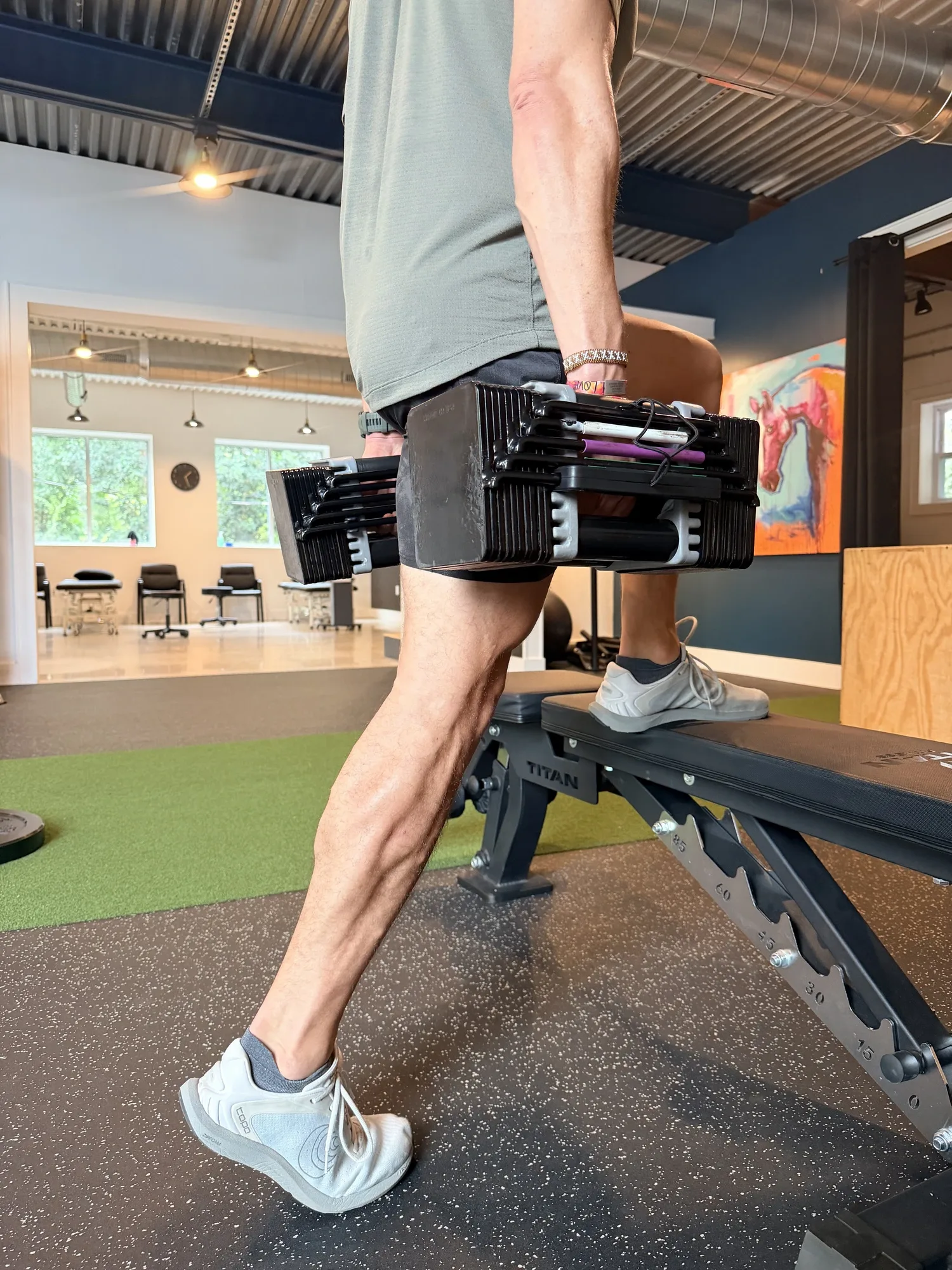
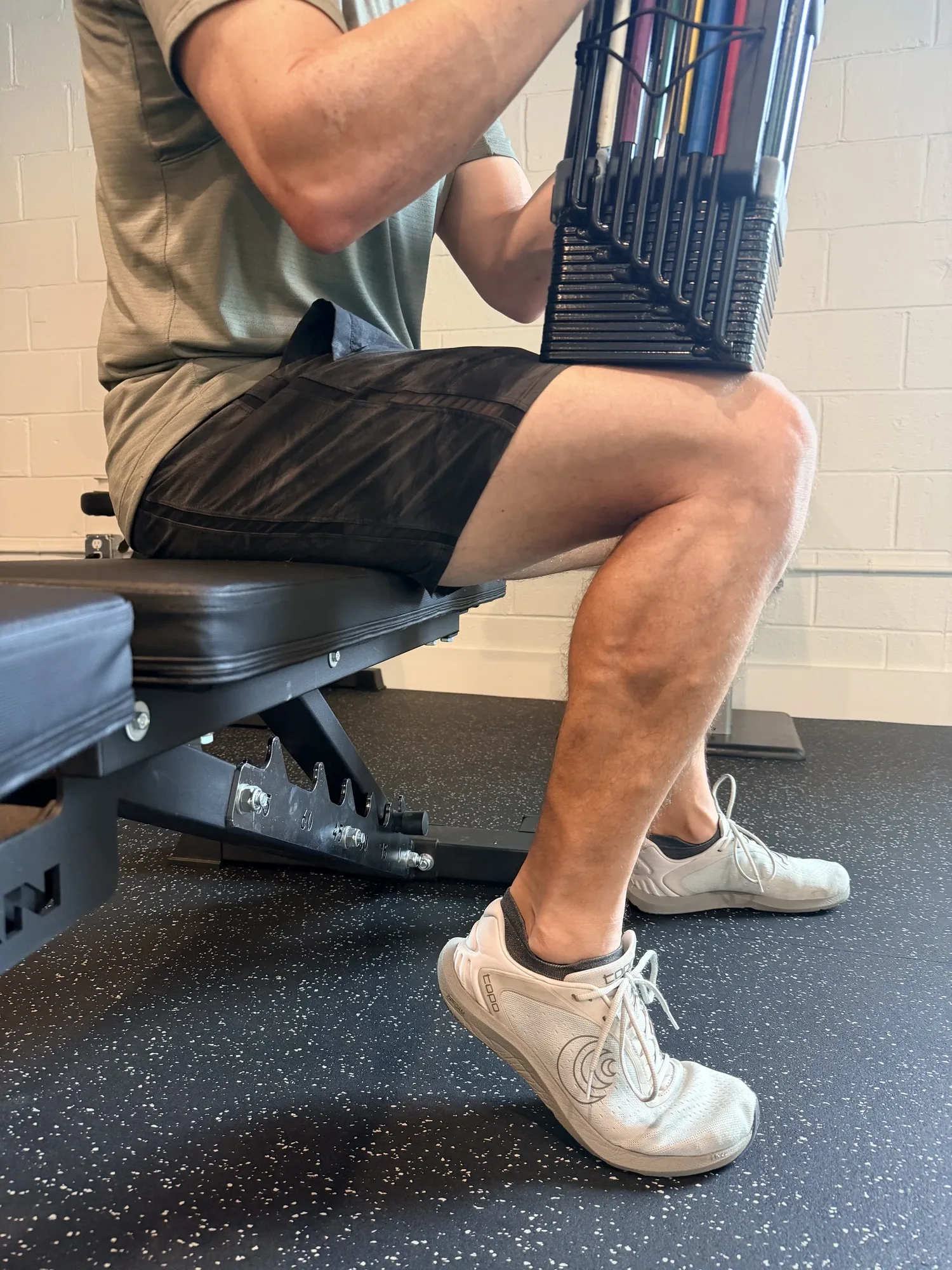
Bent-knee calf raise
With the knee bent, the gastrocnemius is placed in a shortened position at the knee, which reduces its ability to contribute. This makes the exercise more soleus-biased.
Think:
- Seated calf raise
- Bent-knee calf raise
And yes — both are worth training.
The soleus is an especially important contributor to distance running, but the gastrocnemius still plays an important role in propulsion and support. The research consistently identifies the plantarflexors as a major source of force and power during running.
You don’t need to choose one and forget the other.
Train both.
You don’t need fancy equipment
The good news is that there isn’t one magical piece of equipment required to train your calves.
You can perform effective calf loading with:
- A dedicated calf machine
- A leg press
- A squat rack
- Dumbbells
- Kettlebells
- A Smith machine
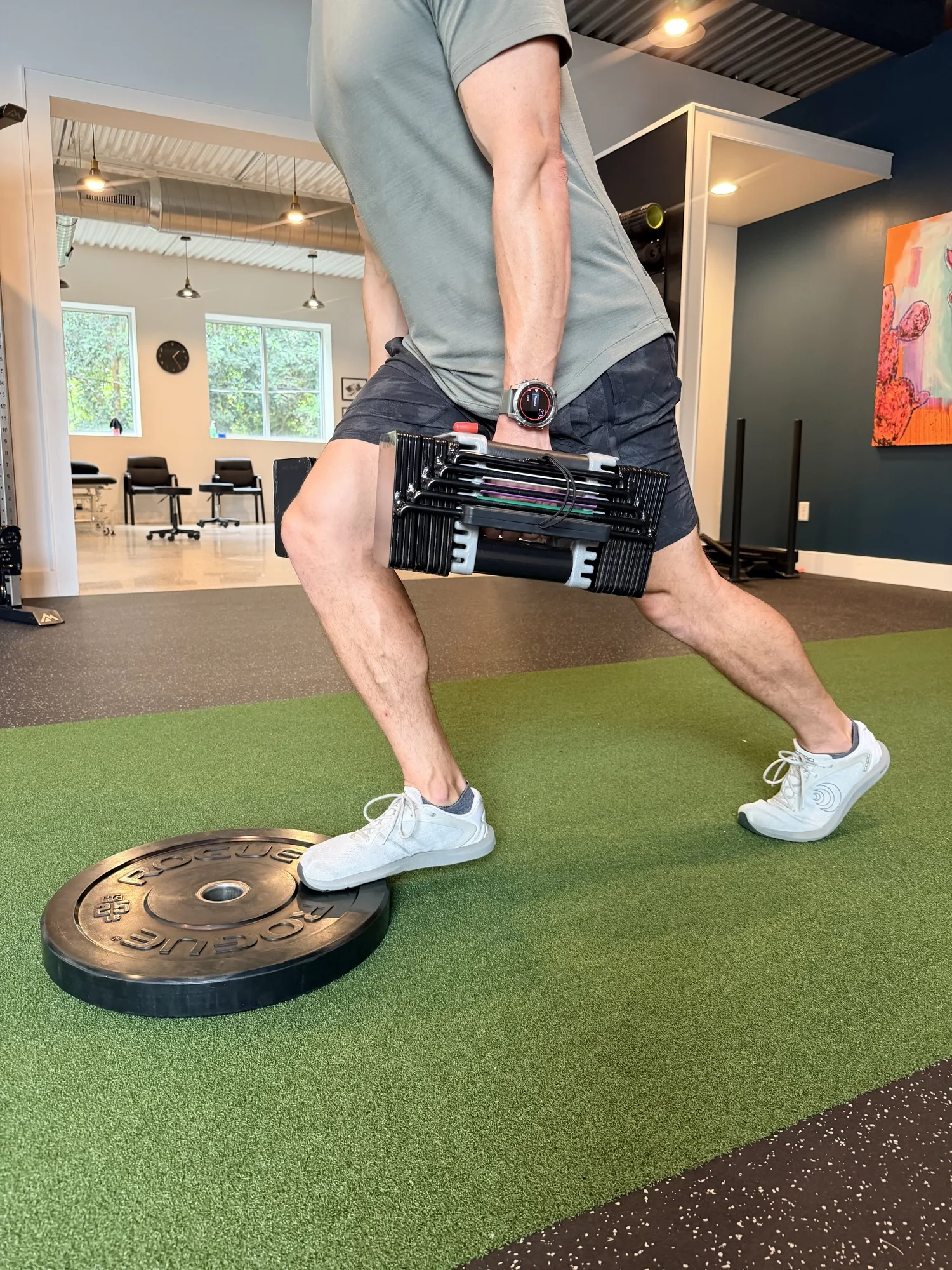
The equipment isn’t the important part.
The dosage is.
If the exercise is challenging enough to provide a meaningful stimulus, you can progressively increase the load over time, and you’re performing it consistently, you’re giving your calf-Achilles system an opportunity to adapt.
What does this mean for runners?
Think about your calf-Achilles system as the spring underneath your running stride.
Every run asks that spring to repeatedly:
- Accept load
- Produce force
- Store elastic energy
- Return energy
- Repeat the process thousands of times
That is a pretty demanding job.
And this is why strength training for runners isn’t about making you look like a bodybuilder or simply making your muscles “strong.”
It’s about building capacity.
The stronger and more capable your calf-Achilles system is, the better equipped it is to handle the demands you’re placing on it through your running.
That doesn’t guarantee you’ll avoid injury — running injuries are much more complicated than simply having a “weak calf.”
But it does give your tissues a larger reserve of capacity to draw from when your training load increases.
If you only have 10–15 minutes…
You don’t need an entire calf workout.
Try:
- Standing calf raise — 3 × 6–8
- or Bent-knee/seated calf raise — 3 × 6–8
- followed by High-intensity calf isometric — 4 × 4 × 4-second holds
Do this 2–3 times per week, alongside your normal strength training, and progressively increase the challenge as your capacity improves.
And once you’ve built a good foundation of strength, we can eventually add another piece to the puzzle: elastic and reactive training — things like hops, pogos and other plyometric exercises that teach your calf-Achilles system to rapidly absorb and return energy.
But that’s a topic for another article.
For now, remember:
Your calves aren’t just helping you finish your stride. They’re helping make the entire stride possible.
And if you’re asking your body to run hundreds — or thousands — of miles a year, they deserve to be trained accordingly.
Want to become a stronger, more resilient runner?
Understanding running biomechanics is one thing. Figuring out what your body specifically needs — and putting that knowledge into practice — is another.
At Swamp Rabbit Physiotherapy and Performance, we work with runners to identify the strength, mobility, movement, and training factors that may be limiting their performance or contributing to recurring injuries.
Whether you’re trying to stay healthy through marathon training, finally break that 5K PR, or simply become a stronger and more confident runner, we’d love to help.
Want to learn more or work with us? Connect with Swamp Rabbit Physiotherapy and Performance to learn more about our running-focused physical therapy and performance services.
Study referenced: Enthalpy efficiency of the soleus muscle contributes to improvements in running economy
Frequently Asked Questions
Ready to make your training bulletproof?
Book a 60-minute assessment with a Doctor of Physical Therapy in Greenville. No referral needed.
Book Your Assessment